At the moment, dev world is full of rave about Node and server side JavaScript (databases like MongoDB and the likes). There hasn't been a better time for front-end and JS developers. On the first look - it appears great, promising and exciting.
On the down side, as with most upcoming technologies, there isn't enough security analysis, consideration and advisory to reference and understand gotchas with server side JS. Nothing wrong with that - it's functions, coolness and innovation that brings business and not security (history/economics is a testimony).
In this post, I will share my security view point as I see it. This could be an ever growing list and the kind of things you can achieve with server side JavaScript - there is no early end to this.
Let's start with the good things. Node inherently introduces a great security benefit over
traditional server side programming paradigms and that is "secure by default" (reminds me of my NetBSD days). As highlighted in white below, your create your web server - a bare bone types and not a full blown with bells and whistles like Apache.

And then chose and pick what you want. Like define what your doc root will have - unlike anything and everything in a traditional web doc root. Like highlighted in yellow below - that is what your web server will respond to for requests. Rest needs to be caught by a 404.

Summarizing - your web server isn't configured and capable more than what you want it to be unlike Apache, Tomcat or IIS. I recall countless instances of Tomcat compromises due to default admin and manager apps that come installed and running with default passwords. And IIS getting exploited with WebDAV buffer overflow when in reality the web app never really needed it in first place. Typically web servers sent a false sense of security where developers mostly considered them to be secure. And we all know, more features, bigger the attack surface. Bigger the attack surface more chances of things going wrong. And something that can go wrong will go wrong!
On the flip side - the bad parts. Node carries over the known dangerous JavaScript APIs like the eval that can be trivially exploited to do server side injection (that were earlier only client side exploits like XSS).
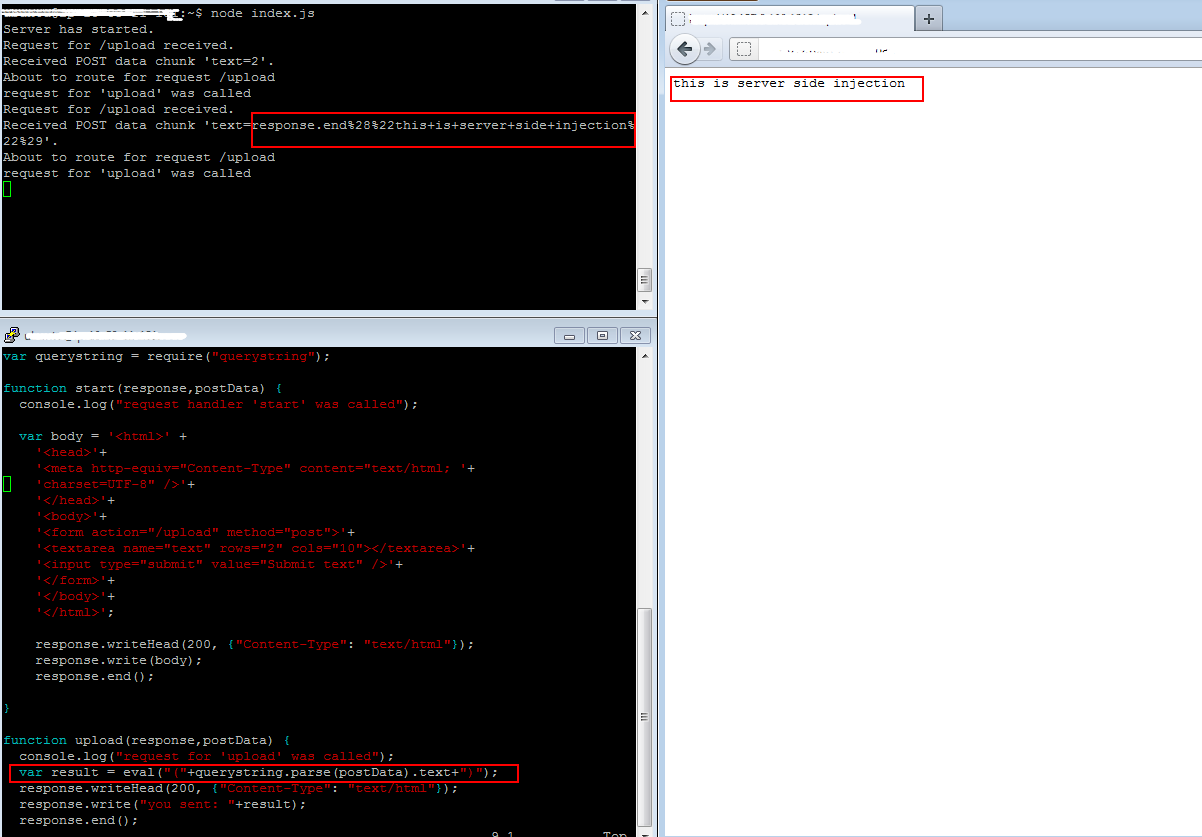
Let's look at a PoC exploit where app evaluates the input and returns an output like below

Abusing eval on client side would result an XSS but on server-side it induces a server side injection alike SQL Injection as seen below where we inject an HTTP response.

The screenshot below highlights execution of server side injection.

To best of my knowledge, this issue was first brought to notice in context of Node by Bryan Sullivan at BlackHat. Not a brand new exploit. We know eval is evil. What is worth note here is most developers wouldn't imagine this happening at the first go. From that perspective this exploit vector server side is novel.
What do I see ugly? The ugly parts are the ones that introduce new attack vectors. There should have been default protection built-in ideally. The event driven single threaded programming model is not what web developers are used to. Node is single threaded and a simple error can create a denial of service condition as highlighted in the screenshot below.
 As highlighted, hitting submit crashes the node server.

Similar DoS condition would result when messing with global variables - intentionally or unintentionally. Above scenarios are quite likely considering JS developers are usually quite used to errors. I see thousands of live sites day in and out that have a number of errors showing up in Firebug console and running absolutely ok which will not be the case as you go server side.
Another ugly part is that web developers are not quite used to service permissioning. Web developers had it outsourced to Apache/IIS, would now end up running their node services as root, that earlier ran as nobody.
A 1000 feet high apple to apple comparison between let's say PHP and Node tells me - it took a step back in security. At least, you would come to expect a sanitization/validation library for a new programming language, if not a fancy new auto-sanitization module like PHP Filter (aah yes - Filter isn't a complete auto sanitization in PHP but you get what I mean).
An honest look and I feel node isn't meant to be used as is. With a strong framework, is how it should be used. There are many in the fray right now - Express probably is the most widely used. I haven't tried it yet but from what I see, security in node is a work in progress.
Being a Yahoo, how can I end without not mentioning Yahoo Cocktails. Haven't played around with it yet, but this is something I have super high hopes with. The engineers I met there are fabulous. Come Q1 2012 it would be there for all of us to play around. Yahoo is a great company, the best I have worked for - no doubt I would love to see it scoring high.
Learning more and more of Node, I keep reminding myself "Node is powerful, and with power comes responsibility".
On the down side, as with most upcoming technologies, there isn't enough security analysis, consideration and advisory to reference and understand gotchas with server side JS. Nothing wrong with that - it's functions, coolness and innovation that brings business and not security (history/economics is a testimony).
In this post, I will share my security view point as I see it. This could be an ever growing list and the kind of things you can achieve with server side JavaScript - there is no early end to this.
Let's start with the good things. Node inherently introduces a great security benefit over
traditional server side programming paradigms and that is "secure by default" (reminds me of my NetBSD days). As highlighted in white below, your create your web server - a bare bone types and not a full blown with bells and whistles like Apache.

And then chose and pick what you want. Like define what your doc root will have - unlike anything and everything in a traditional web doc root. Like highlighted in yellow below - that is what your web server will respond to for requests. Rest needs to be caught by a 404.

Summarizing - your web server isn't configured and capable more than what you want it to be unlike Apache, Tomcat or IIS. I recall countless instances of Tomcat compromises due to default admin and manager apps that come installed and running with default passwords. And IIS getting exploited with WebDAV buffer overflow when in reality the web app never really needed it in first place. Typically web servers sent a false sense of security where developers mostly considered them to be secure. And we all know, more features, bigger the attack surface. Bigger the attack surface more chances of things going wrong. And something that can go wrong will go wrong!
On the flip side - the bad parts. Node carries over the known dangerous JavaScript APIs like the eval that can be trivially exploited to do server side injection (that were earlier only client side exploits like XSS).
Let's look at a PoC exploit where app evaluates the input and returns an output like below

Abusing eval on client side would result an XSS but on server-side it induces a server side injection alike SQL Injection as seen below where we inject an HTTP response.

The screenshot below highlights execution of server side injection.
To best of my knowledge, this issue was first brought to notice in context of Node by Bryan Sullivan at BlackHat. Not a brand new exploit. We know eval is evil. What is worth note here is most developers wouldn't imagine this happening at the first go. From that perspective this exploit vector server side is novel.
What do I see ugly? The ugly parts are the ones that introduce new attack vectors. There should have been default protection built-in ideally. The event driven single threaded programming model is not what web developers are used to. Node is single threaded and a simple error can create a denial of service condition as highlighted in the screenshot below.


Similar DoS condition would result when messing with global variables - intentionally or unintentionally. Above scenarios are quite likely considering JS developers are usually quite used to errors. I see thousands of live sites day in and out that have a number of errors showing up in Firebug console and running absolutely ok which will not be the case as you go server side.
Another ugly part is that web developers are not quite used to service permissioning. Web developers had it outsourced to Apache/IIS, would now end up running their node services as root, that earlier ran as nobody.
A 1000 feet high apple to apple comparison between let's say PHP and Node tells me - it took a step back in security. At least, you would come to expect a sanitization/validation library for a new programming language, if not a fancy new auto-sanitization module like PHP Filter (aah yes - Filter isn't a complete auto sanitization in PHP but you get what I mean).
An honest look and I feel node isn't meant to be used as is. With a strong framework, is how it should be used. There are many in the fray right now - Express probably is the most widely used. I haven't tried it yet but from what I see, security in node is a work in progress.
Being a Yahoo, how can I end without not mentioning Yahoo Cocktails. Haven't played around with it yet, but this is something I have super high hopes with. The engineers I met there are fabulous. Come Q1 2012 it would be there for all of us to play around. Yahoo is a great company, the best I have worked for - no doubt I would love to see it scoring high.
Learning more and more of Node, I keep reminding myself "Node is powerful, and with power comes responsibility".


 Posts
Posts


Great article. We are actually writing a new enterprise app, and now the front-end team are suggesting using node. We have very big clients who always pen-test our current site and security is a big issue! We have actually had to get the team to slow down and consider the security aspects before rushing into this new architecture. I am spending a lot of time researching node from a security and performance/scaling perspective as this is the prime concern from a business angle. Your point about the JS error leading to DOS was a classic example of what we could end up with! The single threaded model has always worried me.
ReplyDeletePlease do give us more updates on node.
Thanks, Zahir.
ReplyDeleteI have had these concerns coming from several folks I meet at conferences and communities.
NodeJS as it is, is not the way to go from what I learn so far. It has to be handled by a framework which should also provide most desired security controls with minimum developer interference especially on things that developers did not expect in other development paradigms and things that were implicit.
Did you experiment with Express? I would be looking into the security aspects of it soon. At the moment, it is Cocktails what I am playing around with.
OVERALL - I would be very cautious for an enterprise app with the maturity of security features available on Node.
If the business decision is hard and you go to use Node, here are some things I think would work but it isn't a complete list:
1. Use a templating framework. I like Ctemplate. Mustache is a derivative of Ctemplate and available for Node. It autoencodes HTML context (not the JS and other contexts like Ctemplate) user input in templates to protect against XSS primarily
2. Hack the HTTP module of Node and auto some filtering there if you could via C module. Esp for SQLi and related input validation issues
3. Use a framework that handles Node errors to avoid DoS
4. CODE DEFENSIVELY. This is the best bet. Like audit usage of eval and the likes.
5. This is not a Node specific issue but watch out for DOM XSS. It is on the rise everyday. Again - code defensively. Avoid document.write and innerHTML instead use innerText or filter user input. Encoding won't save always though due to browser decoding which can again trigger DOM XSS.
I will publish more things along the way. Share some my way if you have any recommendations.
Good luck!
I'm using Node a lot, and I have never used Eval in my code. It seems the whole point here is: do not use eval()! Beyond that, is the security really that bad? If you setup your server with a firewall and you're not a completely ignorant software engineer, it seems your server should be pretty robust.
ReplyDeleteHi Brian - Thanks for sharing your opinion.
ReplyDeleteI think it is much much more than eval. Today I wrote 3 new posts on exactly that.
#1 Global Namespace Pollution http://bishankochher.blogspot.com/2012/02/nodejs-global-namespace-pollution.html
#2 with is evil http://bishankochher.blogspot.com/2012/02/nodejs-with-is-evil.html
#3 switch is evil http://bishankochher.blogspot.com/2012/02/nodejs-switch-is-evil.html
#1 is something that non JS developers aren't used to. #2 and #3 were probably not that serious in the context of client side JS with Node they are really dangerous.
I will be posting more stuff soon. BTW there are also eval cousins like setInterval that are equally dangerous. There is lot more that I worry about on Node.
Do share if you come across something. This is an active area of research.
theese are the *basics* of js gotchas and good practices
Deletedo you have an email address?
Deleteplease send your email to mail.hackx101@gmail.com if you don't mind.
Deletelol
ReplyDeleteAny webserver can be insecure if you code like a dufus.
ReplyDelete++
Delete++++
DeleteAnyone who uses with or eval is an idiot. The only correct eval() use-case is superseded in Node by the VM module.
Switch isn't terrible if you understand how to program.
Just "use strict"
DeletePlease do some research into Node.js. Counterpoints:
ReplyDeleteXSS - This is true of ANY serverside technology. The key here is to escape inputs. Templating systems like express.js handle this for you. If you don't escape input you will see this in ANY serverside stack, java, php, etc.
Crashing - All you need is a global exception handler or to escape input and you are good to go.
XSS:
DeleteAre you sure express.js can defend against XSS in contexts other than HTML? It does not.
i did not find any templating system in Node that does context sensitive output escaping. HTML escaping is simple. And that's what Mu and other engines in Node achieve.
What we need is something like Google Ctemplate http://code.google.com/p/ctemplate/
We did a hack to make it work on Node. So it isn't that difficult. We might OS it after some fine tuning down the line. As of now, it's just a hack
Crashing:
You said it. "All you need" - why should I need to do that. It's got to be the default config. History is full of instances where systems that are secure by default are more resilient than ones that have opt-in security. Worse, this is a break down of paradigm for traditional server side programmers.
XSS is *only* an HTML problem. HTML allows for JavaScript execution inline via script tags and event attributes. Injecting JS into a file served up with any non-HTML & non-JS mimetype is not XSS, as it can't be made to execute without user consent.
DeleteNodeJS is a runtime and an API. There is no reason to bundle a bunch of crap like templating into Node. If you absolutely must use node core for this, use sprintf.
Complaining that Node *allows* you to be a fool when programming is like complaining that your operating system doesn't write your code for you. You are a developer, its your JOB to understand the things required to be good at what you do. No amount of babysitting will fix that.
Crashing: Do not use global exception handler. Use forever or similar tool. When unhandled exception happens application is in undetermined state. If restarting service does not solve anything there is error outside of node script (database etc)
Delete@\0/ bish \0/ - Node isnt just used as a webserver hence no need for that "default config". Besides if u plan to use node.js as a webserver, there are tonnes of modules out there.
Delete"XSS is *only* an HTML problem. HTML allows for JavaScript execution inline via script tags and event attributes. Injecting JS into a file served up with any non-HTML & non-JS mimetype is not XSS, as it can't be made to execute without user consent."
DeleteIncorrect. CSS is surprisingly powerful. Attacks may also be inserted in html attributes, json, url references, practically anywhere including targeting the DOM parser itself.
https://www.owasp.org/index.php/XSS_%28Cross_Site_Scripting%29_Prevention_Cheat_Sheet
It all depends on the attack surface. Just because you're coding a reset server which runs on server side javascript and only outputs json, for example, doesn't mean it's safe against injection.
lol
ReplyDeletehaha
ReplyDeleteI visited your blog for the first time and just been your fan. Keep posting as I am gonna come to read it everyday.
ReplyDelete@washington security systems - thanks for the appreciation. This kind of spurs me to write more often. Another one should be coming soon.
ReplyDeleteYou can leverage a lot of the security issues you mentionned by adding
ReplyDelete'use strict'
at the top of every js files of your project like you would add <?php for a PHP file. Basically, strict mode prevents a lot of common JS mistakes and might even improve performacnes in some situations. Part of the things it prevents :
- with keyword: it is disabled in strict mode and throws an exception if you try to use it
- global namespace pollution: you can't use a variable that has not been declared using var first
It also add a lot of exceptions where before JS code was silently doing nothing. If you write, let's say "delete Object.prototype", withotu strict mode, it was doing nothing (it would be disastrous to remove this prototype right? so it was impossible, but this line was also not doing anything... now you get a nice TypeError if you try this).
If you want more documentation on this : https://developer.mozilla.org/en-US/docs/JavaScript/Reference/Functions_and_function_scope/Strict_mode?redirectlocale=en-US&redirectslug=JavaScript%2FStrict_mode
To make it shorter : use strict mode. That's a HUGE benefit. There was some talk about activating it by default on NodeJS but for some reason it has not been done. So you have to add it as the first line of code in every file. That's a shame but still it leverage a lot of the language biggest issues.
I also want to tell that 'use strict'; also works in browsers. If you want to write clean code, you can. Still, on browser side, since there are old broken browsers, you should not rely on the nice new exceptions for your code to work properly and still tests things out before.
+1
DeleteSo true.
I also forgot to tell one important thing. You don't run NodeJS as root. That's a bad idea. You just don't. Then you will ask me "But how do I listen on port 80?". That's a good one. User land softwares can't listen on ports numbered lower than 1024. So what? It's easy as pie. You just add a nat rule (on Linux using ipnat) to forward port 80 on your internal port xxxx (eg 8000). That would look like:
ReplyDeletesudo iptables -t nat -A PREROUTING -p tcp --dport 80 -j REDIRECT --to-ports 8000
Then if it works as intended, save the change in conf:
sudo service iptables save
sudo chkconfig iptables on
Hope this might help people here address their biggest security issues with NodeJS. I believe there is a lot of good practices to got used to but it will make a better web in the end. I believe NodeJS is a piece of technology that as a great future. Still needs some refining but still... It looks very very promising.
You stole my words. Really.
DeleteBut you forgot to say, another common practice is to have
a reverse-proxy that listens to 80, then drops privileges.
Moreover, you can drop privileges with Node by calling
process.setuid(...), something you can't
normally do with other languages without native extensions.
The whole point of your post should be.. don't use Node.js, if you're an amateur. It's clear that you should use STRICT ECMAScript with Node.js. Don't generalize. If you are a professional, you know where weak points of ECMAScript are. Don't directly interpret input, don't use global variables, unless caching or immediate memory-databases are the actual case.
ReplyDeleteThe most important is: don't use Node.js, if you're an ECMAScript amateur. You'll fuck it up.
http://www.crockford.com/javascript/javascript.html
Yet another blog post warning about eval(), this is just what the world needed. People have been warning about eval() since before JavaScript's inception; Perl for example.
ReplyDeleteI was gonna give this post +1, but I was rickroll'd after seeing the eval code..
ReplyDeleteYour toy it's so beautiful, I like it vey much, I also bought one at cheap prada handbags
ReplyDelete, If you want one too. can visit this address, The backpacks are beautiful at there. I think you will be love it too.
I don't understand why anyone would eval() the contents of any variable that was sent from a form (or URL or any other susceptible location)? Am I reading the code wrong? I'm new to server-side JS using Node and I'm trying to understand some of the security aspects I need to consider.
ReplyDeleteYou are right. This isn't a good example. And some people hated it. I don't blame them. Quite honestly, in my experience I have seen worst (ab)uses of 'eval'
DeleteTo your question, the whole point is - use 'eval' with extreme caution on the server side.
You are comparing apples and oranges. You are comparing using node to the benefits fully featured application framework. If you wanted to comare apples to apples you'd compare node to a Java app opening up a socket to listen on a port (no Tomcat, Spring, JBoss etc) which has all of the same problems listed here (some are easier some are harder)
ReplyDelete+1 - I totally agree that it's not a fair comparison.
DeleteI would add that IMHO it's pretty well known that using node.js to write a web server is not really a smart move. I'm aware the article is old, however it should be made clear that if you want to provide a webserver then use the correct tools. Personally I like node.js for Websockets or other types of custom communications. I wouldn't choose to use it for a webserver, no matter what the form. If your using it for web services, then I believe others have posted comments about appropriate modules to use for this.
Check out: http://www.youtube.com/watch?v=hQVTIJBZook
ReplyDeleteGiven PHP has eval and even most other languages have equivalents I completely fail to see what you mean. SQL injections are the same. SANITIZE INPUTS. Doesn't even matter if there's an eval or not.
ReplyDeleteSaying JavaScript is the bad part of Node basically means the Node engineers did a perfect job. They didn't design Javascript, that was other people.
The spartanism of node by default is what makes it so much more secure. Using a heavy framework will make you lose understanding and simplicity and replace it for the usual mess.
This isn't just about "javascript on the client side". Javascript being expressive/strong enough to be confusing is the only security argument against it. Node itself is small and has so far been very secure.
An operational details like not running as root can also not be blamed upon Node itself. Apache can be run as root just as easily.
Post finds no attachment with me.
I find it highly hillarious that JS developers think having a complete conceptual map of their JS code shitfest means it's secure. How many js parsers have you implemented in a browser? None I'm sure. If you don't understand your platform, you don't understand shit. Ditch this garbage and learn to program in a real language with a real platform if you want to write backend code. Coding defensively only gives you a false sense of security.
ReplyDeleteBest Security Services and security consultants for your business protection and domestic security. Morpheus security company provides efficient, cost effective and reliable security Service 24/7.
ReplyDeletelol
DeleteThis comment has been removed by the author.
ReplyDeleteThe issues with "eval" is more related to bad programming practices than to bad programming language.
ReplyDeleteSecurity Services in Delhi | Best Security Service in Delhi
ReplyDeleteMorpheus security services offers best security services in delhi, best security agencies in Delhi/NCR. Security we provide a comprehensive spectrum of manned security services and security Guard Solutions.
I have a strong background in writing backend software and totally appreciate node.js. ES5 has it's flaws, yes. But there's ES6 which fixes a lot. Regarding speed: the V8 Compiler used in node.js lately whiped out pretty much every other dynamic language implementation and slowly reaches performance areas where only Java or C++ are present. Async is so important these days and node.js makes it dead simple, the callback hell can be solved by using promises (ES6 even supports yield for coroutines).
ReplyDelete@"real" programmers: Alright, you know C and Java, so you think you know software engineering, right ? ES is much more complex than Java or C together. It is far more expressive and has much higher level abstractions. I can only take you guys seriously if you would have 5+ years experience with Haskell/similar. Beyond that all imperative languages are kind of equal, but I would never write again network code in Java or C, it's just a mess, and C is far more insecure than node.js will ever be: C has pointers, yes, when writing drivers they are useful, but totally useless in application code.
A real programmer chooses the tool which fits best, and if I can write productive and safe software 10x times faster than you, than obviously you choose the wrong tool ;)
The wide range of Morpheus Security services offered by us includes guarding Morpheus Security Services in Delhi, Security Services in Delhi.
ReplyDeleteEvent Security Services London is the best firm providing the well trained Professional Security Guard for Personal Security.
ReplyDeleteCommercial video surveillance systems from Protection Concepts based in Marietta, serving the Atlanta area. Monitoring starts at $14.95 a month.
ReplyDeletesecurity systems
Lloyd Security Offers innovative, affordable solutions that deliver greater safety, awareness, control, convenience, and efficiency inside the home and wherever you go.
ReplyDeleteMinnesota commercial security
Minneapolis-based security contractor Lloyd Security works with security systems of your choosing including Residential and Commercial Security.
ReplyDeleteMinnesota contracted surveillance
Replacing batteries in smoke and carbon monoxide detectors is a simple task to provide protection for your family’s security. If you need help with a more sophisticated fire alarm system, give us a call, Lloyd Security can help provide the additional security you want for your home and family.
ReplyDeleteMinneapolis 612.874.9295 | St.paul 651.646.0131 | Toll Free 800.330.0911
Commercial Security Options
Protection Concepts provide you with customized solutions designed for your specific needs, monitor home security systems and commercial security systems, requirements and budget AND remember, our base monitoring starting at just $14.95 per month.
ReplyDeletePersonal Emergency Response System (PERS)
top home security systems
ReplyDeleteGreat blog post! I don’t understand how long it will require me to obtain through all of them!
nice blog ....morpheus security services in Delhi
ReplyDeleteThis is a nice and informative, containing all information and also has a great impact on the new technology. web development company pakistan
ReplyDeleteThe main idea of Node.js, development is use of non-blocking and event-driven I/O to remain insubstantial and efficient in the face of data-intensive real-time applications which run across distributed devices.
ReplyDeleteThis is very essential blog; it helped me a lot whatever you have provided.
ReplyDeleteadt security reviews
This is very interpreting post Thanks for sharing.
ReplyDeletebest website development companies in Pakistan
Nice blog...Mobitsolutions in USA is the best security service provider in USA. We have ensured to our clients to provide them, excellent safety and Security Solutions.
ReplyDeleteThis is my very first time that I am visiting here and I’m truly pleasurable to see everything at one place.
ReplyDeletesurveillance camera pole
Superb posts with lots of information!!! This is really the most miraculous blog site dude….
ReplyDeletesecurity camera system for business
Invictus Security Services is the best security company providing the well trained Professional Security Guard for Personal Security & Event Security.
ReplyDeleteYou have really selected the suitable topic; this is one of my favorite blogs. the owner
ReplyDeleteThis is very essential blog about Security Services it helped me a lot whatever you have provided. This is very interpreting post Thanks for sharing.
ReplyDeleteThe walls, the bars, the guns and the guards can never encircle or hold down the idea of the people.
ReplyDeleteCredit Link: event security guards
I was on rummage around for the sites related to provide good information, so I came up to your site. best home security
ReplyDeleteI generally don’t comment in the Blogs but your blog is the only one that forced me to, amazing work... best home security
ReplyDeleteWhatever you have provided for us in these posts really appreciative. Password Manager
ReplyDeleteThe walls, the bars, the guns and the guards can never encircle or hold down the idea of the people.
ReplyDeleteWhen you are planning a trip to South Africa, flights can make up a large percentage of the trip costs. With ebookers, you can save money by using our powerful search engine to find the best deals on flights to South Africa Cheap Flights to Africa
ReplyDeleteThe good bad or ugly concept about website discussed was really good concept, that helped me to find out a Ac Maintenance in Dubai
ReplyDeleteDo not go away if you looking for “dedicated server in Pakistan”. We provides Reliable Windows / Linux managed and unmanaged dedicated servers hosting.
ReplyDeletehttp://www.softhof.com/dedicated-servers-pakistan.html
Do not go away if you looking for “Cheap Dedicated server in Pakistan”. We provides Reliable Windows / Linux managed and unmanaged dedicated servers hosting.
ReplyDeletehttp://www.softhof.com/dedicated-servers-pakistan.html
You have provided the useful and helpful information. I like the way you written the post on security services. You have raised such great points to think about. Thanks for sharing. If you wish to serve as a security guard in Tennessee, Get complete guidance on how to obtain the Tennessee security guard license.
ReplyDeleteWay cool some valid points! I am grateful for you making this post on hand; the rest of this website is also first-class. Have a great fun. home security systems
ReplyDeleteNode.js is getting more and more mature, no doubt - despite this, not a lot of security guidelines are out there. In this post I will share some points you should keep in mind when it comes to Node.js security.
ReplyDeleteRogers Field University
Good blog along with the excellent quality stuff and I’m sure this will be greatly helpful.full coverage insurance on car
ReplyDeleteWe, at Adroit Security & Service offer escort services requiring assistance when travelling from one place to another. The security officials are professionally qualified, well educated and groomed staff to help the clients in any situation what so ever. We lay special significance on their overall personality development including transmission skills, appearance and presentation.
ReplyDeletehttp://adroitsecurityservice.com
A Cheapest Dedicated Server ideal for businesses wanting to make hugely professional and secure websites. Cheapest Dedicated Server has a range of server hosting all with unique advantages. Softhof offers website server options for all budgets, as each server contains various processing speeds, hard disk space and RAM. We strongly believe that we have the perfect server package for you.
ReplyDeleteA Cheapest Dedicated Server suit your business plan, as we offer packages that adapt to however much you actually require from a web server. Talk to our friendly and helpful support team via phone or email 24/7, who will guide you to the best suits Wen Hosting Plane for you.
We provides Reliable Windows / Linux managed and unmanaged dedicated servers hosting.
I certainly appreciate your stuff provided in the blogs. payday loans
ReplyDeleteSofthof is offering web hosting in Pakistan at cheap price. Our Shared Hosting there is no hidden restriction present. We have our own dedicated servers managed by our staff to ensure 99.99% Uptime. We have Cpanel as a web hosting panel which is the most advanced and rich in features and most used in the world. Our server performance is near 100 % and our server downtime is NIL.
ReplyDeleteweb hosting in pakistan
Softhof offer a range of reliable web hosting services, from Shared, Reseller, VPS Hosting and Dedicated Servers. Shared Web Hosting Packages are very cheap rate in Pakistan in this package we also give you a Free Domain (.com, .net, .org) and 99% uptime, 24x7 support, order today! And get more Discount.
ReplyDeleteSofthof provide latest technologies in ASP.Net, PHP our Web Hosting package starting from just 1500/Year with generous disk space and bandwidth, along with free domain registration. All these features and our speedy customer service make Softhof the best company of its kind in Pakistan.
ReplyDeletewww.softhof.com
Good try as like evergreen information. I really appreciate you on these efforts. home security companies
ReplyDeleteSuperb posts with lots of information!!! This is really the most miraculous blog site dude….payday lenders in new york city
ReplyDeleteEnormous one blog! I have got very clear picture of the topic you shared here that’s truly amazing! lexington law reviews
ReplyDeleteNice working guys, I am cordially with you to appreciate your all posts. home security systems reviews
ReplyDeleteI appreciate everything you have added to my knowledge base.Admiring the time and effort you put into your blog and detailed information you offer.Thanks.
ReplyDeletegoldpromotion.com
You are a really very smart guy! What a beautiful way you have adopted of explaining every aspect of the post. home security systems 1 year contract
ReplyDeleteThe most wide-ranging data I have ever got on this topic on the net. I will be right back soon to the same site…. auto insurance
ReplyDeleteHmm quite interesting site! I really like that thing; I want you to post some more things on that. Bohemian Glass
ReplyDeleteThanks for your interesting article. The content is good and very informative and I personally thank you for sharing nodejs articles.
ReplyDeleteThanks for explaining more about your safety and security! It was very interesting. Do you keep extra supplies on safety measures?
ReplyDeleteNevada security guard training
Hmm that’s blog is so special for me. I love reading this type of knowledge. best home security companies
ReplyDeleteGood post. I like the way you written the post on security. You have raised such great points to think about. Thanks for sharing. Really security guards are very helpful in our day to day life. If you are interested to become a security guard in your place, know the eligibility and its requirements from us.
ReplyDeleteOklahoma Security Guard License
really it could be more useful blog and aware with how to The Beautiful Broken Web there mention with more useful pattern thanks for share this knowledge type post.
ReplyDeleteExpert SEO In Pakistan
Great post thanks for sharing. I would like to recommend people Avyaan. an expert web application security services provider in India. It
ReplyDeleteThanks for this wonderful post and hoping to post more of this! Qadit offers ISO Lead Auditor Training for Information Security Management System(ISMS) in Bangalore. An ISMS protected includes not simply that residing in electronic format on computer or network, but includes paper-based information.ISMS in Bangalore
ReplyDeleteThanks for sharing this blog i have lot of information knows this blog of best home security systems in Bangalore
ReplyDeleteThat’s really so good to visit this site, the blog has helped me a lot in my thesis, before I was quite worried to clear my concepts, thanks car locksmith
ReplyDeleteThe data present in this blog is really marvelous as well as more interesting. Locksmith company
ReplyDeleteThanks for updating with your authentic views in which you talking about beautiful broken Web and please keep sharing some more information.
ReplyDeleteHome Automation Vancouver | vancouver security | Best Security Vancouver
Awesome...
ReplyDeleteOnline Business Directory
A company provides web hosting solutions in Delhi includes shared hosting plans, virtual private server (VPS) hosting plans, dedicated hosting plans, and managed WordPress hosting plans etc.
ReplyDeleteHi there is so many getting information to me, i really like it.
ReplyDeleteThanks.
affordable web hosting
Your blog is really one amongst my most favorite blogs, it’s so creative. keys made
ReplyDeleteJain Technosoft delivers the right solutions to address its clients’ needs with its skilled team of web designers in Bangalore, who provide customized, affordable and beautiful web designs.
ReplyDeleteWeb Developers in Bangalore|Website Designing in Bangalore
Helpful information about Best Web Hosting Companies and where to find the superior internet hosting corporations which might be suitable for businesses & individuals looking to host their own website.
ReplyDeleteFor a limited time, get up to 56% off on select hosting plans: Buy Now
Get Started
That is very good comment you shared.Thank you so much that for you shared those things with us.Im wishing you to carry on with your Achievements.
ReplyDeleteTasty Homemade Food Services
In the form of Inexperienced, Now i'm once and for good seeking via the internet just for articles or reviews which has been about help others. With thanks.
ReplyDeletehttp://melhor-hospedagem-de-sites.strikingly.com/
You’ve put enormous insights about the topic here, continue the good work! Locksmith Newcastle Upon Tyne
ReplyDeleteNode.JS Courses Security TrainingNode.js Training Node js and server side JavaScript databases like MongoDB Courses Training Node js Online Course traditional server side programming Training Courses Node.js paradigms Node.js Essential Training WebDAV buffer overflow Node.js Online Training messing with global variables Courses Node.js Training in Chennai
ReplyDeleteThis is fine anyway nice try guys keep on hard working, truly nice info! safes
ReplyDeleteI was searching for this,.
ReplyDeleteThanks for sharing,..
angularjs
I want to it articles thank for your time of this nice read!!! I definitely enjoy every little bit of it and I have you bookmarked to check out new stuff on your blog a must read blog!!!!Plant growth chamber
ReplyDeleteGeneral Incubator
Laboratory deep freezer
thanks for this info this informations and great ideas websites design services
ReplyDeleteThis prospective but small addition to the FB web pages can have a mighty effect on one's Facebook method. buy 5 star facebook rating
ReplyDeleteKeep sharing more informative posts like that,
ReplyDeleteAngularJs development companies
Thankfulness to my dad who informed me relating to this blog, this website is really amazing.FirstSecurityServices
ReplyDeleteI'd like to know how everything is going with this.
ReplyDeletebest security lancaster pa
I'd like to know how everything is going with this.
ReplyDeletetraining
Thanks for sharing this kind of information. People will surely like this kind of information. Web Designing Bangalore | Website Design Companies Bangalore
ReplyDeleteYou are a extremely clever person!
ReplyDeletehouston security company
I agree CCTV structures are an exceptional obstacle to potential culprits. When they understand that your home or business is ensured by a nearby circuit TV framework they unendingly go elsewhere
ReplyDeleteFor beginners its very important to know all about website designing. You have provide good information regarding this.
ReplyDeleteCado Magenge
"http://appdevelopmentcompany.com.au/web-application-development.html"
Glad to come across this post. I do really appreciate for this information which is indeed very useful for designers. Thanks again and keep posting!
ReplyDeleteThanks for sharing security related informative blog with us.
ReplyDeleteip camera dealers in pune
ReplyDeleteThese are truly amongst the wonderful informative blogs.Thanks for sharing such informative blog article with us.
Security Cameras Richmond | Security Cameras Burnaby
Thanks a lot for sharing this amazing knowledge with us. This site is fantastic. I always find great knowledge from it.
ReplyDeleteValuable information! Looking forward to seeing your notes posted.
ReplyDeleteNode.js jobs in London
Thanks for the information..
ReplyDeletehttp://www.ahlinyamiom.com/
http://www.ahlinyamiom.com/2016/09/06/manfaat-dan-khasiat-kunyit-putih-untuk-miom/
http://www.obatherbalterlaris.com/2016/09/05/obat-obesitas-alami-terbaik/
WebITech is the best Web Hosting Company in Pakistan. We are provided Domain Registration and web designing, Web Hosting, Reseller Hosting, Dedicated Server and VPS Hosting you can also buying at affordable price….
ReplyDeleteWeb Hosting in Pakistan
Your website is for sure worth bookmarking.
ReplyDeletehome
Hi,
ReplyDeleteI’m really impressed with your blog article, such great & useful knowledge you mentioned here
CCTV installer lancaster :-Hughes.solutions offer it support lancaster and it managed services lancaster with affordable cost. Contact us at +44 (0) 1524 238 999
WebITech provide web development, domain registration and web hosting services at cheap price. Get free web hosting in Pakistan from WebITech. WebITech provides 24/7 customer service, 99.9% up-time, and Reliable Web Hosting Service. We are offering Shared Hosting, Portal Hosting, Reseller Hosting, business Hosting, VPS, Dedicated server…….!!
ReplyDeleteWeb Hosting in Pakistan
ReplyDeleteI enjoyed over read your blog post. Your blog have nice information,I got good ideas from this amazing blog. I am always searching like this type blog post. I hope I will see again..
animal jam 2 |2048 game |red ball | stick war 2 |stickman games |five nights at freddy’s 2 |five nights at freddy’s 4 |plants vs zombies |
We contemplated offering popcorn, App Security Analysis, and confection alongside our Mobile App Development in Los Angeles. Our specialization is Mobile App based arrangements. We give end-to-end arrangements from necessities advancement, framework engineering, plan, create, test, and usage.
ReplyDeleteWebitech is one of the best and more reliable company to provide you best and most professional Web Hosting
ReplyDeletein dubai. . Our unlimited Web hosting in dubai is meant for clients that are looking for a single or multiple domain hosting under one business hosting plan and one control panel.
Web Hosting in Dubai
Just remember your stab at this business, should you decide to end it, is not a failure but a training ground. You will take with you what has worked and learned from what has not in order to make the next business idea a success!
ReplyDeletereturn man 2 game , return man 2 ,return man
I wanted to thank you for this excellent read!! I definitely loved every little bit of it.Cheers for the info!!!! & This is the perfect blog for anyone who wants to know about this topic
ReplyDeleteالعاب
العاب اطفال
العاب باربي
العاب مكياج
العاب كراش
العاب مغامرات
We are CCTV Camera Dealers in Ludhiana | Fire Hydrant Dealers . You can contact us any time for more details.
ReplyDeleteAlso, cameras placed near the roof usually have a better field of view and are less likely to be vandalized. Smarter alarm systems
ReplyDeleteYou have shared very interesting and helpful web developing tips. This is the information that i have been looking for long time. Looking for University Coursework Assignment Help? Hire an expert today from our firm and you will never regret.
ReplyDeletegreat blog thanks for sharing..!!!
ReplyDeletewebsite designing
Webitech.pk provide you option of both the Windows and Linux Web Hosting in the same package. Web Hosting in Pakistang. 24/7 Support and reliable Hosting in cheap price. Cheap Web hosting in Lahore, Pakistan.
ReplyDeleteWeb Hosting In Pakistan
Great information thanks for sharing, keep updating.
ReplyDeleteDedicated Servers in India | Cheap Dedicated Hosting India | Dedicated Hosting companies India
Thank you for your valuable information about the nodejs security this is an useful one keep sharing the post like this..
ReplyDeleteGraphic designer jobs in bangalore| Web designer jobs in bangalore
العاب باربي
ReplyDeleteالعاب بنات
Spot on with this article, I really think this website needs more attention. I'll probably be back to read more, thanks for the info.
ReplyDeleteweb hosting reviews
I agree. Can't get much better. You could try http://home-alarm-systems.net
ReplyDeleteLife-time Replacement is something that you barely find, while you Buy facebook reviews. Merely a handful of decent service providers offer up this. buy facebook 5 star rating
ReplyDeletethanks for this informative content. me Definitely gone visit again for more information.
ReplyDeleteThank you for sharing your knowledge with us
node js development company |
javascript development company
React native development company
meteor development company
This medium to large, squarely built dog is highly athletic and one of the most intelligent dog breeds in the world. Sydney CCTV Installation
ReplyDeleteuseful information, for server security, server support, server maintenance we are also work in this industry.
ReplyDeleteSame Day iPhone & Cell Phone Repair Shop - Toughees Telecom
ReplyDeleteSame Day guaranteed iPhone Repairs at your local, Do you need to repair your damaged iPhone 6s or 6s Plus?
Hello my dear,
ReplyDeleteI see your blog every day ... your blog is Very useful for me and I love so much ...
You can see
Looking for cheap wordpress, Linux and windows web hosting service in UK, USA? Web Hosting Watch is the perfect solution for comparing the different web hosts.
Visit Now - Linux web hosting
This will certainly brings favorable results into your company as well as magnify your company sales quickly. You could acquire U.S.A Facebook Suches as on very pocket pleasant prices. buy usa facebook likes
ReplyDeleteThanks for sharing up–to-date on this subject! I find it is very informative and very well written one! Keep up on this quality! JavaScript Development services
ReplyDeleteThere is a lot of excitement about the digitization process but there are many challenges that accompany the process and I am glad that your blog has comprehensively focused on the security issue. I will be recommending this site to our web designers so that they can make our U.K Proofreading Company website more secure. Thanks for sharing the article with us.
ReplyDeleteI just found your blog and want to say thank you! What an enjoyable time looking
ReplyDeletethrough so many sites. Thanks for sharing read more
Security and safety have become a major concern in today’s everyday increasing criminal world. There are a number of security solutions are available in the market that can help you to choose the best locksmith Coquitlam to protect your assets. Best Locksmith can keep your residence or business safe and secure.
ReplyDelete
ReplyDeleteThanks for sharing this great info with us.
Angularjs 2 Development Company
Thanks for Sharing!!
ReplyDeleteIf you are looking for the services like Security Services For Guard in Delhi, then Maxwireless is the fastest growing company in the field of providing Security Services For Guard.
Good blog post about nodejs security. Thanks for sharing this information. go ahead. NodeJS training in Bangalore
ReplyDeletethis site providing good information about NodeJS, To learn NodeJS visit http://iwebworld.info contact: iwebworldinfo@gmail.com
ReplyDeleteNice Blog!!
ReplyDeleteMax Wireless is a private Security Guard Service Proider in Delhi NCR. We provide trained and professional security guard to monitor and protect you from any property damage and criminal activity.
HostOne is providing both cheap and reliable domain registration and web hosting services to our many satisfied customers in Karachi, Lahore, Islamabad and other cities of Pakistan. Web hosting in Pakistan.
ReplyDeleteNice blog.. Thanks for sharing informative blog.. I just want to say that all the information you have given here is awesome...great and nice blog thanks sharing.
ReplyDeleteI have used this code and successfully run. Thank You.
android app development
angularjs freelance work
node js freelancer
ReplyDeleteThis post is absolutely fantastic. Lots of great information. Thank you
Microsoft Server 2016 Repair
Microsoft Server 2016 Installation
Thanks for sharing blog related to Web Application Development Services, It will be benificial for us in web development.
ReplyDeleteWeb Application Development Services
Hai Author Good Information that i found here,do not stop sharing and Please keep updating us..... Thanks.
ReplyDeleteNodejs Development Company
so informative. thanks for sharing Web Hosting
ReplyDeleteNice article great post comment information thanks for sharing
ReplyDeleteพี่มากพระโขนง
Softhof is a reliable hosting company which offers web hosting in Pakistan, domain registration in Pakistan and VPS hosting in Pakistan. Softhof is provide web hosting in Pakistan and it is a specialized in windows hosting as well as Linux web hosting provider company in Pakistan, offers best web hosting services with free domain name. Softhof providing low cost web hosting in Pakistan, with free domain, reseller hosting, dedicated support and your satisfaction as the best web hosting company.
ReplyDeleteWeb Hosting in Pakistan
Its really an awesome post. Thanks for sharing such an excellent post. Keep up your work done.
ReplyDeleteNadkaar - Web Design Dubai
Thanks for the detail about NodeJS. This article really helpful for learning Nodejs. Nodejs Training in Bangalore
ReplyDeleteThanks for sharing this information. Its useful information about Nodejs. Nodejs Training in Bangalore
ReplyDeleteThank you for your valuable information about the node.js development security this is an useful one keep sharing the post like this...Ones again thanks
ReplyDeleteThanks You So Much For Sharing. This is the best way to explain the importance of the Node.js . Many people asks about why node.js is so popular in web application development
ReplyDeleteservices.
web development company sydney
Keep your options open while getting such solutions as there are so many service companies that promises great deal but falls short to deliver the desirable outcomes. buy facebook usa likes
ReplyDeletenemco.com.au
ReplyDeleteNode.js Web Development Services | Node.js Development Company
Nemco is a top level Node.js Development Company based in sydney, Australia. provide supreme Node.js development service. Hire Node.js developers from Nemco
node.js development | node.js development company
We are a professional SEO company in Dubai. Our aim is to help you in growing your business online. We’re expert in organic SEO Dubai, we do our best to get your website ranked on your keywords as soon as possible
ReplyDeleteSEO Dubai
really i quite impressed! Very useful information. Great Post and very good articles.
ReplyDeleteWebsite Development Companies Bangalore
Best website designers in bangalore
Ecommerce Website Design and Development Companies in Bangalore
Outsource magento ecommerce services india
This comment has been removed by the author.
ReplyDeleteThis comment has been removed by the author.
ReplyDeleteNadkaar is passionate about designing and crafting a well thought-out plan for our clients that include, web design and development, SEO, digital marketing, UI/UX.
ReplyDeleteSEO dubai
Very glad to read your blog.Thank you for sharing this article.It is great!
ReplyDeleteWeb development company in bangalore
Outsource magento ecommerce services india
ECommerce Website developers in bangalore
This comment has been removed by the author.
ReplyDeletegood one, im waiting for more articlest like this. keep up the good work.
ReplyDeleteSEO Dubai
This comment has been removed by the author.
ReplyDeleteNice Post! Deciding on the Node.js web application framework for your project, you should pay attention to the following criteria: Community. Documentation. Versions upgrading. Scalability. System resources loading. Performance. Simplicity of development and testing. Availability and variety of modules.
ReplyDeletenode.js development company
Excellent tips. Really useful stuff .Never had an idea about this, will look for more of such informative posts from your side... Good job...Keep it up
ReplyDeletenode.js development
node.js development company
node.js development services
node.js development Sydney
It is very useful information and iam very glad to be part in this blog and keep sharing Thank you.
ReplyDeleteBest Meanstack Training in Hyderabad
Meanstack Training in Ameerpet
Best Meanstack Training in Ameerpet
Wow, happy to see this awesome post. I hope this think help any newbie for their awesome work. By the way thanks for share this awesomeness from commercial security systems
ReplyDelete
ReplyDeleteNeeded to compose you a very little word to thank you yet again regarding the nice suggestions you’ve contributed here.
Mean Stack Training in Bangalore
Welcome to the heart burning city Mussoorie the night ruler of slopes, we are Call Girls specialist organization offering a VIP gathering of escort young ladies. We turn state of mind sexier of every sharp people and adventurer who visit Escort in mussoorie to invest a remarkable energy of their life.
ReplyDeleteThanks for the post. You have explained the topic in very simple and step by step.
ReplyDeletenode js developer london
One of the best security service provider in delhi like Corporate Security Services, Industrial Security Services, ATM Security Guard Service, Office Security Services, Residential Security Services, Mall Security Services
ReplyDeleteSecurity Services
Event Management Security Service
Bouncer Security Services
Armed Guard Services
Commercial Housekeeping Services
Manpower Security Services
Thank you for providing the valuable information.
ReplyDeleteNode JS Online Training
Nice post,thanks for giving this post this is very useful to every one and like this types also good explanation.thank you
ReplyDeleteInfrastructure erp software in chennai
Hi, Great.. post is just awesome..It is really helpful for a newbie like me.. I am a regular follower of your blog. Really very informative post you shared here. Kindly keep blogging.
ReplyDeleteData Science Training in Chennai
Data science training in bangalore
Data science online training
Data science training in pune
Data science training in kalyan nagar
All the points you described so beautiful. Every time i read your i blog and i am so surprised that how you can write so well.
ReplyDeletejava training in chennai | java training in bangalore
java online training | java training in pune
selenium training in chennai
selenium training in bangalore